
Radial Nerve Palsy: Treatment for Wrist Drop and Hand Weakness
Waking up unable to lift your wrist or straighten your fingers is alarming. Radial nerve palsy often improves on its own over weeks to months, and when it doesn’t, there are effective options to restore function.
What Is Radial Nerve Palsy?
The radial nerve runs from the neck down the back of the upper arm, wraps around the arm bone (humerus), and continues into the forearm and hand. It controls the muscles that straighten the elbow, lift the wrist and straighten the fingers and thumb, and gives feeling to the back of the hand.
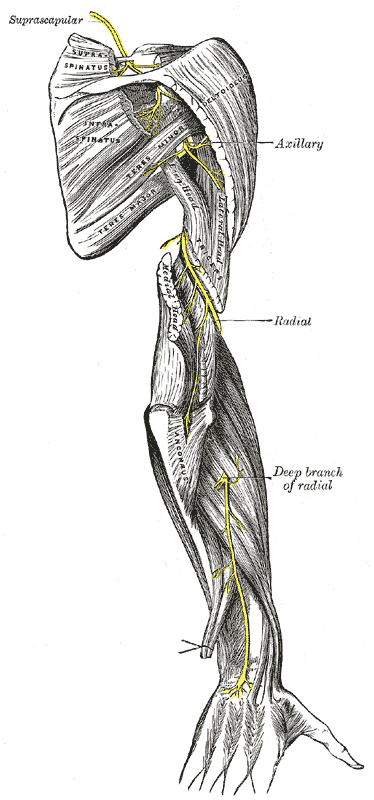
Radial nerve palsy is weakness or paralysis caused by injury or compression of the radial nerve. The classic sign is “wrist drop,” where the wrist and fingers hang down and can’t be lifted.
Symptoms
- Wrist drop: trouble lifting the wrist
- Trouble straightening the fingers or thumb
- Weak grip, since the wrist can’t be held in position
- Numbness on the back of the hand, especially between the thumb and index finger
- Elbow weakness, if the injury is high in the arm
A related condition
Compression of a branch of the radial nerve in the forearm (posterior interosseous nerve or radial tunnel syndrome) can cause finger weakness or forearm pain without numbness.
Causes and Risk Factors
- Pressure on the upper arm: such as falling asleep with the arm draped over a chair (“Saturday night palsy”) or using crutches incorrectly
- Fractures of the humerus (upper arm bone)
- Elbow injuries or dislocations
- Tight casts, tourniquets or prolonged positioning
- Nerve tumors, cysts or masses
- Cuts or penetrating injuries
How We Diagnose Radial Nerve Palsy
- History and exam: testing which muscles are weak and where sensation is lost to pinpoint the injury
- EMG/nerve conduction studies: usually done a few weeks after the injury to show the location and severity and track recovery
- X-rays: when a fracture is suspected
- Ultrasound or MRI: to look at the nerve and for any mass or scarring
- Neck evaluation: to rule out a C7 nerve root problem in the neck, which can mimic radial nerve weakness
Treatment Options
Non-surgical treatment comes first
Most radial nerve palsies caused by pressure improve on their own over weeks to a few months as the nerve heals.
- Wrist splint: holds the wrist up so you can use your hand and protects the tendons
- Hand therapy: keeps joints flexible and builds strength as the nerve recovers
- Avoiding further pressure on the nerve
- Repeat exams and nerve testing to track recovery
If surgery is needed
Surgery is considered when there’s no sign of recovery after about three to six months, when the nerve was cut or badly injured, or when a mass or scar is compressing it. If surgery is needed, we typically refer you to an upper extremity specialist who focuses on nerve and tendon surgery of the arm and hand.
Why See Dr. Betsy Grunch for Radial Nerve Palsy
- Duke-trained: neurosurgical residency and spine research fellowship at Duke University School of Medicine, where she received the Spine Young Investigator Award
- Experience you can count on: in practice since 2013, caring for thousands of patients with nerve and spine conditions
- Neck or nerve? She can tell: as a neurosurgeon who treats the spine and peripheral nerves, she can sort out whether wrist and hand weakness comes from a pinched nerve in the neck or the radial nerve in the arm
- The right next step: board-certified (FAANS, FACS, FCNS), she guides your recovery and, if surgery is needed, refers you to a trusted upper extremity specialist
- Clear answers: known online as Ladyspinedoc, she makes sure you understand your diagnosis and what to expect as the nerve heals
What to Expect During Recovery
- Weeks 1-4: a wrist splint keeps your hand usable and protects the tendons
- Months 1-3: hand therapy maintains motion and builds strength; many pressure-related palsies improve in this window
- Months 3-6: repeat exams and nerve testing check progress; referral to an upper extremity specialist if recovery stalls
- Long term: nerves regrow slowly, about an inch a month, so full recovery can take many months
Frequently Asked Questions
Will my wrist drop get better on its own?
Often yes, especially when caused by pressure. Most people recover over weeks to a few months.
What is “Saturday night palsy”?
Radial nerve compression from sleeping with the arm draped over a chair or under a partner, often after deep sleep or alcohol.
Why should I wear a splint?
A splint keeps the wrist in a useful position, lets you use your hand and prevents stiffness while the nerve heals.
When should I worry that it’s not getting better?
If there’s no improvement after a few months, further testing and a referral to an upper extremity specialist should be considered.
Could this be coming from my neck?
Sometimes. A C7 nerve root problem in the neck can cause similar weakness, which is why a careful exam matters.
Take the First Step Toward Relief
Whether you need a diagnosis, a treatment plan or a second opinion, Dr. Grunch and the Southern Neurosurgery team are here to help.
Call 470-293-9800 to schedule an appointment or contact us online.
Have a question first? Ask our virtual assistant anything, 24/7.
We see patients across metro Atlanta and North Georgia at our offices in Gainesville, Sandy Springs and South Atlanta (Riverdale). Find the office nearest you.
This page is for educational purposes only and is not a substitute for medical advice. If you have sudden, severe weakness or numbness, especially on one side of the body or with trouble speaking, call 911 or go to the nearest emergency room.