
Relieving Pressure on the Median Nerve
Numb, tingling fingers that wake you at night, or a hand that drops things, can wear you down. Carpal tunnel release is one of the most common hand surgeries, and it can often correct the problem by giving the median nerve more room at the wrist.
What Is Carpal Tunnel Release?
The carpal tunnel is a narrow passage at the base of the palm, formed by the wrist bones and a tough band of tissue called the transverse carpal ligament. The median nerve and the tendons that bend your fingers run through it. In carpal tunnel syndrome, the nerve is squeezed, causing numbness and tingling in the thumb, index, middle and ring fingers, hand pain and weakness.
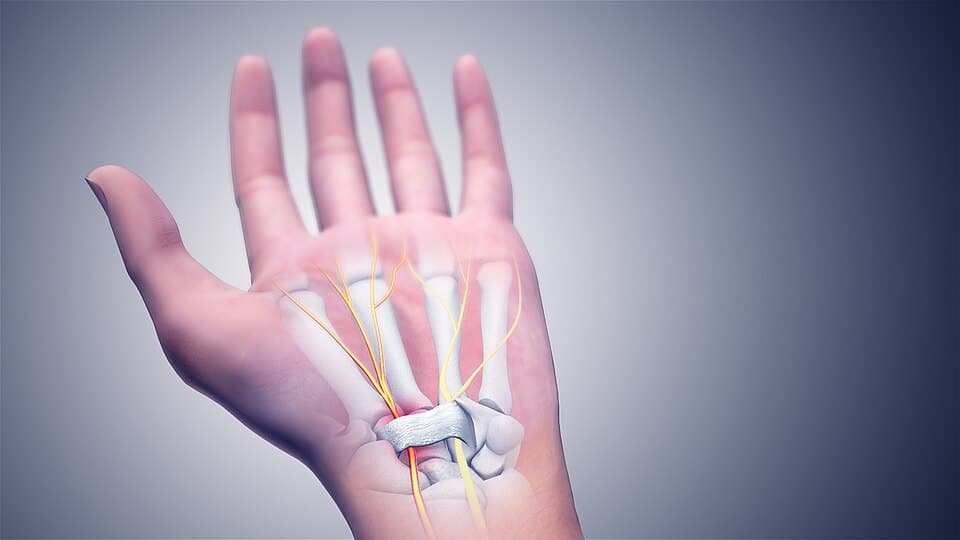
Carpal tunnel release is surgery to cut the transverse carpal ligament. This opens the tunnel and takes pressure off the nerve. The ligament heals with more room for the nerve.
Who Needs Carpal Tunnel Release?
- Numbness and tingling that keep coming back despite a splint and other treatment
- Symptoms that wake you up at night or interfere with work and daily activities
- Weakness, clumsiness or dropping things
- Shrinking of the muscles at the base of the thumb
- Nerve testing (EMG and nerve conduction studies) showing moderate or severe compression
Treatments to Try First
- Wrist splint: worn at night to keep the wrist straight
- Activity changes: taking breaks from repetitive gripping, typing or vibrating tools
- Medications: anti-inflammatory medicines for short-term relief
- Steroid injection: into the carpal tunnel, which can relieve symptoms for weeks to months
When symptoms persist or the nerve is losing function, surgery can often correct the problem.
How Carpal Tunnel Release Is Done
- Anesthesia: Usually an outpatient procedure with numbing medicine and light sedation.
- Incision: A small incision is made in the palm.
- Releasing the ligament: The transverse carpal ligament is carefully divided while the median nerve is protected.
- Closing: The skin is closed with stitches and a soft dressing is applied.
Watch Dr. Grunch explain how carpal tunnel syndrome is diagnosed and treated:

Video: Case Study 82, Carpal Tunnel Syndrome Diagnosis and Treatment, explained by Dr. Grunch on her Ladyspinedoc channel (YouTube)
Benefits and Risks
Benefits
- Relieves numbness, tingling and night pain, often quickly
- Can improve grip and hand function
- Prevents further nerve damage
- Usually a short outpatient procedure
Risks
- Tenderness in the palm (pillar pain) for several weeks
- Infection or bleeding
- Injury to the nerve or its small branches, which is rare
- Symptoms that don’t fully go away, especially when the nerve was badly compressed for a long time
- Risks related to anesthesia
Why Choose Dr. Betsy Grunch for Your Carpal Tunnel Release
- Duke-trained: Dr. Grunch completed her neurosurgical residency at Duke University School of Medicine, one of the top neurosurgery programs in the country.
- A nerve specialist: Neurosurgeons are trained in the entire nervous system, from the brain and spine to the nerves in the arms and legs. Dr. Grunch can tell whether your symptoms come from a pinched nerve in the neck or back or from a trapped nerve in the limb, so the right problem gets treated.
- Experience you can count on: She has been in practice since 2013 and performs 400 to 600 surgeries a year, more than 5,000 procedures over her career.
- A teacher at heart: As “Ladyspinedoc,” she is known for explaining nerve and spine conditions clearly. You’ll leave your visit understanding your diagnosis and every option in front of you.
What to Expect
Before surgery
You’ll meet with Dr. Grunch or one of her physician assistants to review your symptoms, exam and nerve testing, and to decide together whether carpal tunnel release is right for you. Our team will review your medications (including blood thinners you may need to pause) and walk you through the day of surgery. You may have nerve testing (EMG and nerve conduction studies) to confirm the diagnosis.
Procedure day
Carpal tunnel release usually takes less than 30 minutes, and you go home the same day.
Recovery timeline
- First days: Keep the hand raised. Night numbness and tingling often improve quickly.
- Two weeks: Stitches are removed at your follow-up visit.
- Four to six weeks: Most people return to light work and daily activities. Palm tenderness gradually fades.
- Three months and beyond: Strength continues to return. When the nerve was badly compressed, numbness can take many months to improve.
Watch Dr. Grunch’s post-op care tips:

Video: Post-op Care for Carpal Tunnel Surgery, from Dr. Grunch on her Ladyspinedoc channel (YouTube)
Caring for yourself at home
- Your incision: Remove the dressing on day three and leave the stitches in place. You may shower starting day three. Gently clean the incision and pat it dry without scrubbing. Leave it open to air, and don’t use ointments or creams. A small amount of brownish-red drainage for a few days is normal.
- No soaking: Don’t soak the incision in a bath, hot tub or pool for six weeks and until any scabs are gone.
- Swelling: For the first few days, raise your hand above the level of your heart for about 30 minutes every two to three hours.
- Activity: Limit use of the operated hand and wrist while the incision heals. You may use it to dress yourself and for self-care. Protect the incision from bumping or rubbing on hard surfaces.
- Medications: Take pain medication with food and avoid alcohol while taking it. Most people need it for up to two weeks. Take a daily stool softener and a laxative as needed. Don’t take blood thinners such as aspirin, warfarin, Xarelto or Plavix for five to seven days after surgery, until the office tells you to restart them.
- Driving: You may drive once you’re no longer taking narcotic pain medication. Riding as a passenger is fine.
- Smoking: Smoking slows healing. Our office can help if you’d like to quit.
- Follow-up: Your visit is about two weeks after surgery, when any stitches are removed. If you can’t work during recovery, our office can complete employer paperwork.
Call the office at 470-293-9800 if you have a fever over 101°F, redness, warmth or significant drainage from the incision, new weakness or numbness that wasn’t there before surgery, calf pain or swelling, or constipation that medication doesn’t relieve. Call 911 for chest pain or shortness of breath.
Download your patient packet
Print your patient packet or save it to your phone so you have it before and after surgery. It explains your surgery, includes your post-operative instructions and shows how to reach our 24/7 Virtual Assistant:
See all patient packets to find instructions for other surgeries and our Surgery Day Guides.
Frequently Asked Questions
Am I awake for carpal tunnel surgery?
Most people have numbing medicine with light sedation, so they are relaxed and comfortable.
How soon will my numbness improve?
Night symptoms often improve within days. Numbness that has been present for a long time can take several months to improve.
When can I go back to work?
Many people return to desk work within a week or two and to heavier hand use in about four to six weeks.
Can carpal tunnel come back?
It’s uncommon after a complete release, but it can happen.
Can both hands be done at once?
Usually one hand is done at a time so you can still use the other hand for daily activities.
Take the Next Step
If numbness and tingling in your hands are keeping you up at night, you don’t have to live with it. Whether you need a diagnosis, a treatment plan or a second opinion, Dr. Grunch and the Southern Neurosurgery team are here to help you understand your options.
Call 470-293-9800 to schedule an appointment or contact us online.
Have a question first? Ask our virtual assistant anything, 24/7.
We see patients across metro Atlanta and North Georgia at our offices in Gainesville, Sandy Springs and South Atlanta (Riverdale). Find the office nearest you.
Related pages: Carpal tunnel syndrome · Cubital tunnel release · Peripheral nerve decompression · Cervical radiculopathy
This page is for educational purposes only and is not medical advice. It does not replace individualized care from a licensed physician. If you have sudden weakness, numbness or loss of function, call 911 or go to the nearest emergency room.