
Treating Disc-Related Back Pain While Preserving Movement
When a worn disc in the lower back is the source of your pain and other treatments haven’t helped, a lumbar disc replacement can often correct the problem while preserving motion in your spine.
What Is a Lumbar Disc Replacement?
A lumbar disc replacement, also called lumbar total disc replacement or arthroplasty, removes a damaged disc in the lower back and replaces it with an artificial disc designed to move like a healthy one. It is an alternative to a lumbar fusion for the right patients with degenerative disc disease and discogenic back pain.
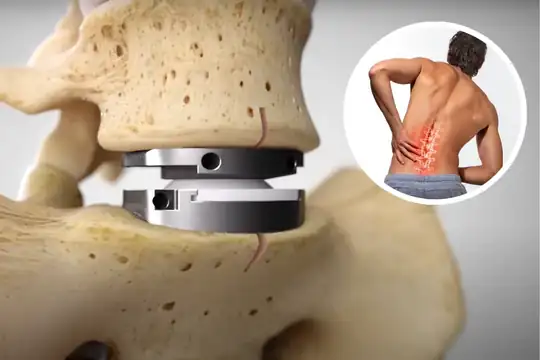
Dr. Grunch uses prodisc L from Centinel Spine, an FDA-approved artificial disc for the lower spine between L3 and S1. It is the only lumbar total disc replacement approved in the United States for use at two levels. The implant has two metal endplates that anchor to the vertebrae and a medical-grade plastic inlay that allows the spine to bend and twist naturally.
Lumbar disc replacement is one of Dr. Grunch’s signature procedures.

Why prodisc L? Video courtesy of Centinel Spine.
Who Is a Candidate?
Candidates generally have:
- Back pain coming from one or two damaged discs, most often at L4-L5 and/or L5-S1
- Pain that hasn’t improved after at least six months of good conservative treatment
- Good bone strength (a normal bone density scan)
- No significant arthritis in the facet joints at the back of the spine
- No major prior lumbar surgery, significant deformity or instability
A worn disc on an MRI alone doesn’t mean you need surgery. Dr. Grunch makes sure the imaging findings match your symptoms. When it isn’t clear which disc is causing the pain, she may order additional testing such as discography or a Nociscan to pinpoint the painful disc. Osteoporosis, spinal instability, significant deformity or substantial narrowing around the nerves may make disc replacement unsuitable, and a fusion may be the better choice.
Treatments to Try First
- Physical therapy: core strengthening and a structured exercise program
- Medications: anti-inflammatory medications and muscle relaxers for flare-ups
- Weight management and activity changes to reduce stress on the discs
- Injections: epidural steroid injections for associated leg pain
When these no longer keep you active, surgery can often correct the problem.
How a Lumbar Disc Replacement Is Done
- Anesthesia: You’ll be fully asleep, lying on your back.
- Access from the front: The spine is reached through an incision on the lower abdomen. The abdominal organs and blood vessels are gently moved aside, often with the help of a vascular access surgeon, without cutting the back muscles.
- Removing the disc: The damaged disc is removed completely, and the nerves are freed if needed.
- Restoring height: The disc space is gently opened to restore its normal height.
- Placing the artificial disc: Using live X-ray, the prodisc L implant is sized and placed precisely between the vertebrae.
- Closing: The abdominal incision is closed with dissolvable stitches and skin glue.
In this video, spine surgeons explain why reaching the spine from the front can be easier on your body:

From the Front to the Back: why anterior spine surgery. Video courtesy of Centinel Spine.
For a closer look, this surgical technique animation shows each step of placing a prodisc L artificial disc. It includes surgical detail:

prodisc L surgical technique animation. Video courtesy of Centinel Spine.
Benefits and Risks
Benefits
- Significant relief of disc-related back pain for most well-selected patients
- Preserves motion at the treated level instead of fusing it
- May lower stress on neighboring discs compared with a fusion
- No need to wait for bone to fuse, and the back muscles are left untouched
Risks
- Injury to blood vessels or abdominal organs during the approach, which is uncommon
- Infection or bleeding
- Temporary bowel slowing after surgery, or rarely a hernia at the incision
- In men, a rare risk of retrograde ejaculation from the approach
- Implant movement or wear, or ongoing pain from the facet joints, which can require another surgery
- Risks related to anesthesia, including blood clots
Why Choose Dr. Betsy Grunch for Your Lumbar Disc Replacement
- Duke-trained: Dr. Grunch completed her neurosurgical residency and a spine research fellowship at Duke University School of Medicine, one of the top neurosurgery programs in the country, where she received the Spine Young Investigator Award.
- Motion-preservation expertise: Cervical and lumbar artificial disc replacement are among her signature procedures, so fusion isn’t your only option.
- Experience you can count on: She has been in practice since 2013 and performs 400 to 600 surgeries a year, more than 5,000 procedures over her career.
- Precise diagnosis: She uses discography and Nociscan, when needed, to confirm which disc is causing your pain before recommending surgery.
- Second opinions and revisions: She regularly sees patients who had spine surgery elsewhere and want a second opinion or need a revision.
- A teacher at heart: As “Ladyspinedoc,” she is known for explaining spine conditions clearly. You’ll leave your visit understanding your imaging and every option in front of you.
Watch one of Dr. Grunch’s patients share his experience with lumbar total disc replacement:

Patient testimonial: Sam C., lumbar total disc replacement
Hear from a five-time PGA Tour winner about his experience with prodisc:

prodisc patient story: five-time PGA Tour winner Brian Gay. Video courtesy of Centinel Spine.
What to Expect
Before surgery
You’ll meet with Dr. Grunch or one of her physician assistants to review your imaging, your exam and your goals, and to decide together whether a lumbar disc replacement is right for you. Our team will coordinate any pre-operative testing, review your medications (including blood thinners you may need to pause) and walk you through the day of surgery so nothing is a surprise. If you smoke or use nicotine, stopping before surgery lowers the risk of complications.
Procedure day
The surgery usually takes two to three hours. Patients generally stay one night in the hospital. You’ll be up and walking by the day after surgery, and you’ll start with a light diet while your bowels wake up.
Recovery timeline
- First two weeks: Walk every day and gradually increase your distance. Soreness at the incision and in the back is normal.
- Two to six weeks: Avoid heavy lifting and high-impact activity. Many people with desk jobs return to work in about four to six weeks.
- Four to six weeks: Your follow-up visit with Dr. Grunch. Physical therapy may begin.
- Six to twelve weeks and beyond: Most patients return to normal activities, including exercise. Physically demanding jobs may take six to twelve weeks.
Every patient heals differently. Your exact timeline will depend on your symptoms, your job and your overall health.
Watch this short video comparing total disc replacement and fusion:

Total disc replacement as a fusion alternative. Video courtesy of Centinel Spine.
Watch Dr. Grunch’s post-op care instructions:

Video: Post-op Care for Lumbar Disc Replacement, from Dr. Grunch on her Ladyspinedoc channel (YouTube)
Download your patient packet
Print your patient packet or save it to your phone so you have it before and after surgery. It explains your surgery, includes your post-operative instructions and shows how to reach our 24/7 Virtual Assistant:
See all patient packets to find instructions for other surgeries and our Surgery Day Guides.
Read more in Dr. Grunch’s article, Lumbar Disc Replacement: Who It’s For and How It Compares to Fusion.
Frequently Asked Questions
How is a disc replacement different from a fusion?
Both treat a painful, damaged disc. A fusion joins two vertebrae so they stop moving. A disc replacement keeps that level moving, which may reduce stress on the discs above and below.
Why is the surgery done through the abdomen?
Going through the front lets the surgeon remove the entire disc and place the implant precisely, without cutting the back muscles or disturbing the nerves at the back of the spine.
Can two levels be replaced?
Yes. prodisc L is the only lumbar disc replacement in the U.S. approved for two levels, such as L4-L5 and L5-S1 together.
How long does an artificial disc last?
Artificial discs are built to last many years, and long-term studies of prodisc L have shown durable results. Dr. Grunch will follow you with periodic X-rays.
Am I too old for a disc replacement?
Age alone isn’t the deciding factor. Bone strength, facet joint health and the cause of your pain matter more. Dr. Grunch will review your imaging and bone density with you.
Take the First Step Toward Relief
If you’ve been told fusion is your only option for back pain, it may be worth a second look. Whether you need a treatment plan, a second opinion or a clear explanation of your imaging, Dr. Grunch and the Southern Neurosurgery team are here to help.
Call 470-293-9800 to schedule an appointment or contact us online.
Have a question first? Ask our virtual assistant anything, 24/7.
We see patients across metro Atlanta and North Georgia at our offices in Gainesville, Sandy Springs and South Atlanta (Riverdale). Find the office nearest you.
Related pages: Degenerative disc disease · Discogenic back pain · Disc replacement candidates · Lumbar fusion · Cervical disc replacement
This page is for educational purposes only and is not medical advice. It does not replace individualized care from a licensed physician. Please talk with your own doctor about your symptoms. If you have sudden weakness, trouble walking, or new bladder or bowel problems, call 911 or go to the nearest emergency room.